It Is Not Accidental Therefore Tha Thte Biblical Story of the Fall Is Centered Again on Food
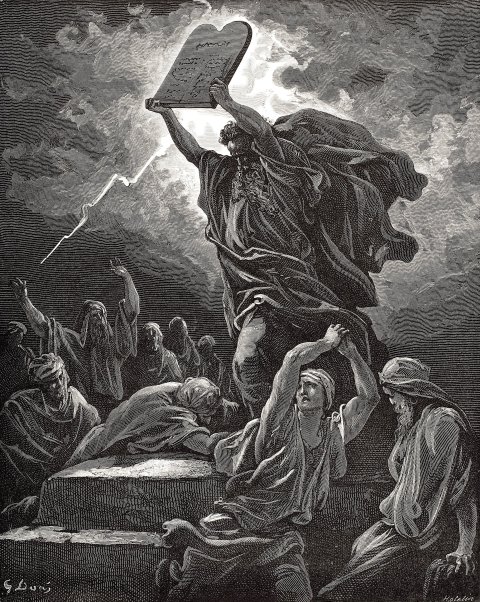
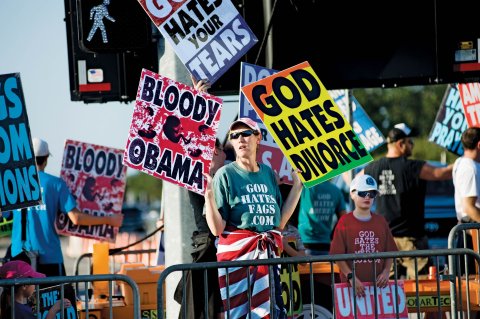
They wave their Bibles at passersby, screaming their condemnations of homosexuals. They fall on their knees, worshipping at the base of operations of granite monuments to the Ten Commandments while demanding prayer in school. They appeal to God to relieve America from their political opponents, more often than not Democrats. They gather in football stadiums by the thousands to pray for the country's salvation.
They are God's frauds, cafeteria Christians who pick and choose which Bible verses they heed with less intendance than they exercise in selecting side orders for lunch. They are joined by religious rationalizers—fundamentalists who, unable to detect Scripture supporting their biases and behavior, twist phrases and modify translations to prove they are honoring the Bible's words.
This is no longer a affair of personal or private faith. With politicians, social leaders and even some clergy invoking a book they seem to accept never read and whose phrases they don't understand, America is existence besieged past Biblical illiteracy. Climatic change is said to be impossible because of promises God fabricated to Noah; Mosaic law from the Old Testament directs American government; creationism should exist taught in schools; helping Syrians resist chemical weapons attacks is a sign of the end times—all of these arguments take been advanced by modern evangelical politicians and their brethren, yet none of them are supported in the Scriptures as they were originally written.
The Bible is not the volume many American fundamentalists and political opportunists think it is, or more precisely, what they desire it to be. Their lack of noesis about the Bible is well established. A Pew Research poll in 2010 found that evangelicals ranked only a smidgen higher than atheists in familiarity with the New Attestation and Jesus'south teachings. "Americans revere the Bible—but, generally, they don't read it,'' wrote George Gallup Jr. and Jim Castelli, pollsters and researchers whose piece of work focused on religion in the United states. The Barna Group, a Christian polling firm, institute in 2012 that evangelicals accepted the attitudes and beliefs of the Pharisees—religious leaders depicted throughout the New Attestation as opposing Christ and his bulletin—more they accepted the teachings of Jesus.
Newsweek's exploration here of the Bible's history and significant is not intended to accelerate a particular theology or debate the beingness of God. Rather, it is designed to shine a lite on a volume that has been abused by people who claim to revere information technology but don't read it, in the process creating misery for others. When the illiteracy of self-proclaimed Biblical literalists leads parents to banish children from their homes, when it sets neighbor confronting neighbor, when information technology engenders hate and condemnation, when it impedes science and undermines intellectual advancement, the topic has become as well important for Americans to ignore, whether they are deeply devout or tepidly faithful, believers or atheists.
This test—based in large part on the works of scores of theologians and scholars, some of which dates dorsum centuries—is a review of the Bible's history and a recounting of its words. Information technology is only through accepting where the Bible comes from— and who put information technology together—that anyone can encompass what history's most of import book says and, only as important, what it does not say.
Playing Phone with the Word of God
No goggle box preacher has ever read the Bible. Neither has whatever evangelical political leader. Neither has the pope. Neither take I. And neither take you. At best, we've all read a bad translation—a translation of translations of translations of hand-copied copies of copies of copies of copies, and on and on, hundreds of times.
Near 400 years passed between the writing of the first Christian manuscripts and their compilation into the New Testament. (That's the same amount of time between the inflow of the Pilgrims on the Mayflower and today.) The showtime books of the Old Attestation were written 1,000 years before that. In other words, some 1,500 years passed betwixt the twenty-four hours the first biblical author put stick to clay and when the books that would get the New Testament were chosen. There were no printing presses beforehand or until ane,000 years later on. There were no vacuum-sealed technologies to preserve paper for centuries. Dried clay broke, papyrus and parchment crumbled away, primitive inks faded.
Back then, writings from one era could be passed to the next only by copying them by hand. While there were professional person scribes whose lives were dedicated to this grueling work, they did not start copying the letters and testaments nigh Jesus'southward fourth dimension until centuries after they were written. Prior to that, amateurs handled the task.
These manuscripts were originally written in Koiné, or "common" Greek, and not all of the amateur copyists spoke the language or were even fully literate. Some copied the script without understanding the words. And Koiné was written in what is known every bit scriptio continua—meaning no spaces between words and no punctuation. And then, a sentence like weshouldgoeatmom could be interpreted every bit "We should go eat, Mom," or "We should go swallow Mom." Sentences can take different pregnant depending on where the spaces are placed. For example, godisnowhere could be "God is now hither" or "God is nowhere."
None of this mattered for centuries, because Christians were sure God had guided the hand not but of the original writers but likewise of all those copyists. Simply in the past 100 years or so, tens of thousands of manuscripts of the New Testament have been discovered, dating dorsum centuries. And what biblical scholars now know is that subsequently versions of the books differ significantly from earlier ones—in fact, even copies from the aforementioned fourth dimension periods differ from each other. "There are more variations among our manuscripts than there are words in the New Testament," says Dr. Bart D. Ehrman, a groundbreaking biblical scholar and professor at the University of Due north Carolina who has written many books on the New Testament.
Virtually of those discrepancies are petty more than than the handwritten equivalent of a typo, but that error was then included by future scribes. There were besides minor changes made by literate scribes centuries afterwards the manuscripts were written because of what they decided were flaws in the accounts they were recopying. For case, an early on version of Luke 3:sixteen in the New Testament said, "John answered, saying to all of them.…" The problem was that no one had asked John anything, then a 5th century scribe fixed that by changing the words to "John, knowing what they were thinking, said.…" Today, most mod English Bibles have returned to the correct, yet confusing, "John answered." Others, such as the New Life Version Bible, use other words that newspaper over the inconsistency.
But this give-and-take is almost something much more than important than whether some scribe in the Middle Ages decided God had not been paying attending while guiding the hand of Luke. Indeed, at that place are significant differences in copies that touch on far more profound bug. Scribes added whole sections of the New Testament, and removed words and sentences that contradicted emerging orthodox beliefs.
Take one of the nigh famous tales from the New Testament, which starts in John 7:53. A group of Pharisees and others bring a adult female caught committing infidelity to Jesus. Under Mosaic Law—the laws of Moses handed downwards in the Quondam Testament—she must be stoned to death. The Pharisees enquire Jesus whether the woman should exist released or killed, hoping to force him to choose betwixt honoring Mosaic Law and his teachings of forgiveness. Jesus replies, "He that is without sin among you, let him outset cast a stone.'' The group leaves, and Jesus tells the woman to sin no more than.
It's a powerful story, known even by those with only a passing knowledge of the Bible. It was depicted in Mel Gibson'southward movie The Passion of the Christ and is often used to point out the hypocrisy of Christians who denounce what they perceive to exist the sins of others. Unfortunately, John didn't write it. Scribes made it up sometime in the Centre Ages. It does not appear in any of the iii other Gospels or in whatsoever of the early Greek versions of John. Fifty-fifty if the Gospel of John is an infallible telling of the history of Jesus'due south ministry building, the event just never happened. Moreover, according to Ehrman, the writing style for that story is different from the rest of John, and the department includes phrases that do non appear anywhere else in the Bible. Scholars say they are words more usually used long after that Gospel was written.
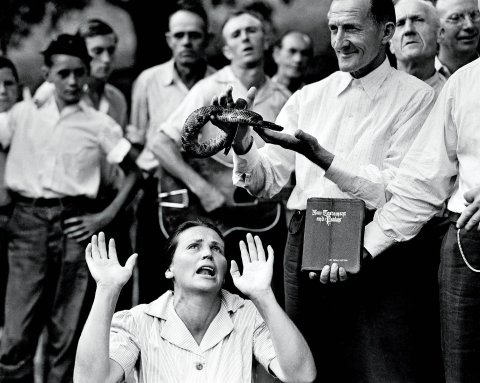
For Pentecostal Christians, an important section of the Bible appears in the Gospel of Mark, xvi:17-18. These verses say that those who believe in Jesus will speak in tongues and accept boggling powers, such as the ability to cast out demons, heal the sick and handle snakes. Pentecostal ministers often babble incomprehensible sounds, proclaiming—based in part on these verses in Mark—that the noises they are making prove that the Holy Spirit is in them. It'southward also a primary justification for the emergence of the Pentecostal serpent-handlers.
But once again, the verses came from a artistic scribe long after the Gospel of Mark was written. In fact, the earliest versions of Mark stop at sixteen:8. It's an bad-mannered ending, with iii women who have gone to the tomb where Jesus was laid after the Crucifixion encountering a man who tells them to let the disciples know that the resurrected Jesus will come across them in Galilee. The women flee the tomb, and "neither said they any thing to any man; for they were afraid.''
In early copies of the original Greek writings, that's it. The 12 verses that follow in modern Bibles—Jesus appearing to Mary Magdalene and the Disciples and and then ascending to Heaven—are not in that location. A significant moment that would be hard to forget, ane would think.
The same is truthful for other critical portions of the Bible, such every bit 1 John five:7 ("For in that location are three that deport record in heaven, the Father, the Discussion, and the Holy Ghost: and these three are one"); Luke 22:20 ("Besides too the cup after supper, maxim, This cup is the new testament in my blood, which is shed for you"); and Luke 24:51 ("And it came to pass, while he blessed them, he was parted from them, and carried up into sky"). These first appeared in manuscripts used by the translators who created the King James Bible, but are not in the Greek copies from hundreds of years earlier.
These are not the only parts of the Bible that announced to have been added much later. There are many, many more—in fact, far more can be explored without filling up the next several issues of Newsweek.
Translation Transubstantiation
So comes the problem of accurate translation. Many words in New Testament Greek don't have articulate English equivalents. Sentence construction, idioms, stylistic differences—all of these are challenges when converting versions of the New Testament books into English. And this can't be solved with a Berlitz class: Koiné is ancient Greek and not spoken anymore. This is why English language translations differ, with many having been revised to reflect the views and guesses of the modern translators.
The gold standard of English language Bibles is the King James Version, completed in 1611, but that was not a translation of the original Greek. Instead, a Church building of England committee relied primarily on Latin manuscripts translated from Greek. Co-ordinate to Jason David BeDuhn, a professor of religious studies at Northern Arizona University and author of Truth in Translation, it was ofttimes very hard for the committee to find the right English language words. The committee sometimes compared Latin translations with the earlier Greek copies, institute discrepancies and decided that the Latin version—the later version—was correct and the earlier Greek manuscripts were incorrect.
The goal of the translators was to create a Bible that was a gorgeous work that was very accurate in its translation and clear in its meaning, merely that didn't happen. "The King James Bible is a cute piece of English literature,'' says BeDuhn. "In terms of the other 2 goals, however, this translation falls short."
For subsequent English Bibles, those slightly off translations in King James were then often converted into phrases that most closely fitted the preconceptions of even more translators. In other words, religious convictions determined translation choices. For example, προσκυνέω, a Greek word used most 60 times in the New Attestation, equates to something forth the lines of "to prostrate oneself" besides as "to praise God." That was translated into Latin equally "adoro,'' which in the Male monarch James Bible became "worship." Merely those two words don't mean precisely the aforementioned matter. When the King James Bible was written, "worship" could be used to depict both exhibiting reverence for God and prostrating oneself. While non perfect, it's a decent translation.
As a upshot, throughout the King James Bible, people "worship" many things. A slave worships his owner, the assembled of Satan worship an angel, and Roman soldiers mocking Jesus worship him. In each of these instances, the word does non mean "praise God'south glory" or anything similar that; instead, information technology means to bow or prostrate oneself. But English language Bibles adopted afterwards—the New International Bible, the New American Standard Bible, the Living Bible and so on—dropped the discussion worship when information technology referenced anyone other than God or Jesus. And and so each time προσκυνέω appeared in the Greek manuscript regarding Jesus, in these newer Bibles he is worshipped, merely when applied to someone else, the verbal same word is translated as "bow" or something similar. Past translating the same word different means, these modernistic Bibles are calculation a flake of linguistic support to the idea that the people who knew Jesus understood him to be God.
In other words, with a trivial translational trickery, a central tenet of Christianity—that Jesus is God—was reinforced in the Bible, even in places where it directly contradicts the residue of the verse.

That kind of manipulation occurs many times. In Philippians, the King James Version translates some words to designate Jesus as "beingness in the form of God." The Greek word for form could simply mean Jesus was in the image of God. But the publishers of some Bibles decided to insert their beliefs into translations that had nothing to do with the Greek. The Living Bible, for example, says Jesus "was God"—even though modern translators pretty much merely invented the words.
Which raises a big outcome for Christians: the Trinity—the conventionalities that Jesus and God are the same and, with the Holy Spirit, are a single entity—is a fundamental, yet deeply confusing, tenet. And then where does the clear annunciation of God and Jesus as office of a triumvirate appear in the Greek manuscripts?
Nowhere. And in that deception lies a story of mass killings.
The Sociopath Emperor
Why would God, in conveying his message to the globe, speak in whispers and riddles? It seems nonsensical, but the conventionalities that he refused to convey a clear bulletin has led to the slaughter of many thousands of Christians by Christians. In fact, Christians are believed to accept massacred more followers of Jesus than whatsoever other group or nation.
Those who believed in the Trinity butchered Christians who didn't. Groups who believed Jesus was two entities—God and human—killed those who thought Jesus was but flesh and blood. Some felt certain God inspired Old Testament Scriptures, others were convinced they were the production of a dissimilar, evil God. Some believed the Crucifixion brought salvation to humankind, others insisted it didn't, and withal others believed Jesus wasn't crucified.
Indeed, for hundreds of years after the death of Jesus, groups adopted radically alien writings about the details of his life and the meaning of his ministry, and murdered those who disagreed. For many centuries, Christianity was showtime a battle of books then a battle of blood. The reason, in large office, was that in that location were no universally accepted manuscripts that set out what information technology meant to be a Christian, then near sects had their ain gospels.
There was the Gospel of Mary Magdalene, the Gospel of Simon Peter, the Gospel of Philip and the Gospel of Barnabas. One sect of Christianity—the Gnostics—believed that the disciple Thomas was non only Jesus's twin brother but also the founder of churches across Asia. Christianity was in chaos in its early days, with some sects declaring the others heretics. Then, in the early 300s, Emperor Constantine of Rome declared he had become follower of Jesus, ended his empire'south persecution of Christians and set up out to reconcile the disputes among the sects. Constantine was a brutal sociopath who murdered his eldest son, decapitated his brother-in-law and killed his wife by humid her live, and that was after he proclaimed that he had converted from worshipping the dominicus god to existence a Christian. Yet he also changed the grade of Christian history, ultimately influencing which books made it into the New Testament.
Past that bespeak, the primary disputes centered on whether Jesus was God—the followers of a priest named Arius said no, that God created Jesus. But the Bishop of Alexander said yes, that Jesus had existed throughout all eternity. The dispute raged on in the streets of Constantinople, with everyone—shopkeepers, bakers and tradesmen—arguing about which view was correct. Constantine, in a reflection of his shallow agreement of theology, was annoyed that what he considered a minor dispute was causing such turmoil, and feared that information technology weaken him politically. So he decided to strength an agreement on the question.
Constantine convened a meeting in the lakeside town of Nicaea. Invitations were sent around the world to bishops and leaders of diverse sects, although not all of them. The grouping included the educated and the illiterate, zealots and hermits. Constantine arrived wearing jewels and gold on his ruby robe and pearls on his crown, eager to talk over the truthful essence of a poor carpenter who had died 300 years earlier.
Things that are today accepted without much thought were adopted or reinforced at Nicaea. For case, the Old Testament was clear in declaring that God rested on the 7th day, making it the Sabbath. The 7th mean solar day of the week is Saturday, the day of Jewish worship and remainder. (Jesus himself invoked the holiness of the Jewish Sabbath.) The give-and-take Sunday does not appear in the Bible, either equally the Sabbath or anything else. Merely 4 years before Nicaea, Constantine alleged Sun as a day of balance in honor of the sun god.
At Nicaea, rules were adopted regarding the proper positions for prayer on Sundays—continuing, not kneeling; nothing was said of the Jewish Sabbath or Saturday. Many theologians and Christian historians believe that it was at this moment, to satisfy Constantine and his commitment to his empire'due south many sun worshippers, that the Holy Sabbath was moved by one day, contradicting the articulate words of what ultimately became the Bible. And while the Bible mentioned nil about the day of Jesus'south birth, the birth of the sun god was historic on December 25 in Rome; Christian historians of the 12th century wrote that it was the heathen vacation that led to the designation of that appointment for Christmas.
The bulk of the fourth dimension at Nicaea was spent debating whether Jesus was a homo who was the son of God, equally Arius proclaimed, or God himself, as the church building bureaucracy maintained. The followers of Arius marshaled evidence from the letters of Paul and other Christian writings. In the Gospel of Marking, speaking of the Second Coming, Jesus said, "But of that day and that 60 minutes knoweth no man, no, not the angels which are in heaven, neither the Son, but the Begetter." In Paul'due south first letter to the Corinthians, he wrote that "there is but ane God, the Father…and in that location is but one Lord, Jesus Christ." In his letter to Timothy, Paul wrote, "For there is i God, and one mediator between God and men, the man Christ Jesus."
Paul'due south writings are consistent in his reference to God every bit one being and Jesus as his son. Aforementioned with the Gospel of Matthew, where Peter tells Jesus that he is the "Son of the living God" and Jesus responds that "Flesh and blood hath non revealed information technology unto thee, but my Father which is in heaven.'' Jesus fifty-fifty chosen out to God every bit his "Male parent" every bit he was dying on the cross.
But Constantine sided with those who believed Jesus was both God and homo, then a statement of conventionalities, chosen the Nicene Creed, was composed to proclaim that. Those who refused to sign the statement were banished. Others were slaughtered. After they had returned domicile and were far from Rome, some who signed the document afterwards sent letters to Constantine saying they had only done so out of fear for their lives.
Well-nigh l years after, in A.D. 381, the Romans held another meeting, this time in Constantinople. At that place, a new agreement was reached—Jesus wasn't ii, he was now iii—Male parent, Son and Holy Ghost. The Nicene Creed was rewritten, and those who refused to sign the argument were banished, and another wholesale slaughter began, this fourth dimension of those who rejected the Trinity, a concept that is nowhere in the original Greek manuscripts and is often contradicted by it.
To this twenty-four hour period, congregants in Christian churches at Sunday services worldwide recite the Nicene Creed, which serves as affidavit of their conventionalities in the Trinity. It is doubtful many of them know the words they utter are not from the Bible, and were the cause of so much bloodshed. (Some mod Christians attempt to use the Gospel of John to justify the Trinity—even though it doesn't explicitly mention it—merely they are relying on bad translations of the Greek and sentences inserted by scribes.)
To sympathize how what we call the Bible was made, yous must see how the behavior that became function of Christian orthodoxy were pushed into information technology by the Holy Roman Empire. By the 5th century, the political and theological councils voted on which of the many Gospels in apportionment were to brand upwardly the New Testament. With the power of Rome behind them, the practitioners of this proclaimed orthodoxy wiped out other sects and tried to destroy every copy of their Gospels and other writings.
And call back that they were already working from a fundamentally flawed certificate. Errors and revisions by copyists had been written in past the 5th century, and several books of the New Attestation, including some attributed to Paul, are now considered forgeries perpetrated by famous figures in Christianity to bolster their theological arguments. It is small wonder, so, that there are so many contradictions in the New Testament. Some of those contradictions are trivial, but some create huge problems for evangelicals insisting they are living by the word of God.
No 3 Kings?
To illustrate how even seemingly trivial contradictions can have profound consequences, let'southward recount the story of Christmas.
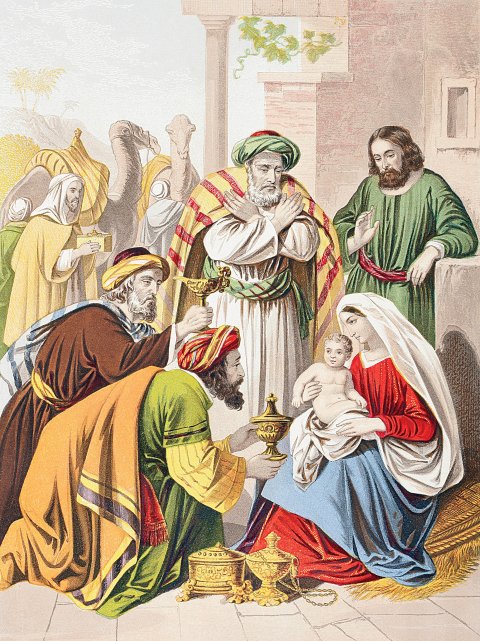
Jesus was born in a business firm in Bethlehem. His male parent, Joseph, had been planning to divorce Mary until he dreamed that she'd conceived a child through the Holy Spirit. No wise men showed up for the nativity, and no brilliant star shone overhead. Joseph and his family then fled to Egypt, where they remained for years. After, they returned to Israel, hoping to live in Judea, merely that proved problematic, so they settled in a small town called Nazareth.
Not the version y'all are familiar with? No angel actualization to Mary? Non born in a manger? No one maxim there was no room at the inn? No gilded, frankincense or myrrh? Fleeing to Egypt? Offset living in Nazareth when Jesus was a child, not before he was born?
You may not recognize this version, simply it is a story of Jesus's birth found in the Gospels. Two Gospels—Matthew and Luke—tell the story of when Jesus was born, but in quite dissimilar ways. Contradictions grow. In creating the familiar Christmas tale, Christians took a piffling scrap of one story, mixed information technology with a little chip of the other and ignored all of the contradictions in the 2. The version recounted above does the same; it uses parts of those stories from the two Gospels that are usually ignored. So in that location are two blended versions and two Gospel versions. Take your pick.
There are too deep, logical flaws hither that should be apparent to anyone giving the Bible a close read. Many Christians read the Sometime Attestation as having several prophecies that the Messiah will be a descendant of David, a towering biblical figure who was the second ruler of the Kingdom of Israel. And both Matthew and Luke offer that proof—both trace Jesus's lineage to his father Joseph and from there back to David.
Except…Joseph wasn't Jesus's father. Jesus is the son of God, remember? Moreover, the genealogies recounted in the two Gospels are dissimilar, each identifying different men as Joseph's father and grandad. Mary, the mother of Jesus, can be the only parent with a bloodline to David, but neither Gospel makes any mention of that.
The stories in the four Gospels of Jesus's death and resurrection differ likewise. When brought before Pontius Pilate in the Gospel of Mark, Jesus speaks only ii words and is never alleged innocent. In the Gospel of John, Jesus engages in extended conversations with Pilate, who repeatedly proclaims this Jewish prisoner to be innocent and deserving of release. (The Volume of John was the final to be written and came at a fourth dimension when gentiles in Rome were gaining dramatically more than influence over Christianity; that explains why the Romans are largely absolved from responsibility for Jesus's death and blame instead is pointed toward the Jews. That has been one of the key bases for centuries of anti-Semitism.)
And who went to bless Jesus in his tomb? In Matthew, it was Mary and another woman named Mary, and an angel met them there. In Mark, it was Mary Magdalene, Mary the mother of James, and Salome, and a young man met them. In John, it was Mary lone; no one met her. As told in Matthew, the disciples go to Galilee subsequently the Crucifixion and see Jesus ascend to heaven; in Acts, written past Luke, the disciples stay in Jerusalem and see Jesus arise from there.
Some of the contradictions are conflicts between what evangelicals consider absolute and what Jesus actually said. For example, evangelicals are ever talking about family values. Merely to Jesus, family was an impediment to reaching God. In the Gospel of Matthew, he states, "And every one that hath forsaken houses, or brethren, or sisters, or father, or mother, or married woman, or children, or lands, for my proper name'south sake, shall receive an hundredfold, and shall inherit everlasting life."
Then there is what many fundamentalist Christians agree to exist the most important of all elements of the Bible: the Second Coming of Christ and the end of the world. What modern evangelicals want to believe cannot exist reconciled with the Bible. In the Gospel of Mark, Jesus says of the Apocalypse, "This generation shall not pass, till all these things be washed"—in other words, the people alive in his time would come across the finish of the globe. Paul in 1 Corinthians is even clearer; he states, "The time is brusk." He then instructs other Christians, given that the finish is coming, to live equally if they had no wives, and, if they purchase things, to treat them as if they were non their own. Some evangelicals counter these articulate words by quoting 2 Peter as saying that, for God, one day is like ane,000 years.
Two bug: That does cipher to counter what either Jesus or Paul said. And even in ancient times, many Christian leaders proclaimed 2 Peter to be a forgery, an opinion almost universally shared by biblical scholars today.
None of this is meant to demean the Bible, but all of it is fact. Christians angered past these facts should be angry with the Bible, not the messenger.
God Wrestling Dragons
The next fourth dimension someone tells you the biblical story of Cosmos is true, enquire that person, "Which one?"
Few of the Christian faithful seem to know the Bible contains multiple cosmos stories. The offset appears on Page one, Genesis 1, and so that is the version most people tend to embrace. All the same, information technology isn't hard to discover the second version: Information technology's Genesis 2, which usually starts on the same folio. Genesis 1 begins with the words "In the starting time, God created the heavens and the earth"; Genesis ii starts with "This is the business relationship of the heavens and the earth when they were created."
Careful readers have long known that the ii stories contradict each other. Genesis 1 begins with expanses of water that God separates, creating the globe between them. Genesis ii describes a world without enough water, which is and then introduced. Vegetation exists before the sun and the stars in Genesis 1; it's the other way around in Genesis ii. In Genesis 1, homo is created after plants and animals; in Genesis 2, plants and animals come after homo. In Genesis ane, Adam and Eve are created together; in Genesis two, Eve is created out of Adam's rib.
This is nothing unusual for the Onetime Attestation. In fact, even though many evangelical Christians insist that Moses wrote the get-go five books of the One-time Testament (including Deuteronomy, which talks about Moses having died and been buried), biblical scholars accept ended that 2 Jewish sects wrote many of the books. Each prepared its version of Former Testament, and the 2 were joined together without whatsoever try to reconcile the many contradictions.
These duplications are known as "doublets." "In most cases," says Richard Elliott Friedman, a biblical scholar at the University of Georgia, "one of the versions of the doublet story would refer to the deity by the divine name Yahweh, and the other version of the story would refer to the deity simply as God." Once the different narratives appearing in the Bible were divided by the word they used to reference God, other terms and characteristics turned up repeatedly in one or the other grouping. "This tended to support the hypothesis that someone had taken two different onetime source documents, cutting them up and woven them together" in the first five books of the Onetime Testament, Friedman says.
The doublets make reading the Erstwhile Testament the literary equivalent of a hall of mirrors. Take the Genesis story of Noah and the inundation. In Genesis 6, God tells Noah to build an ark and load information technology with animals, and "Noah did everything just as God commanded him." So, in Genesis vii, God again tells Noah to load the ark with animals, and "Noah did all that the Lord commanded him." Nether the first set of instructions, Noah was to bring two of every kind of creature onto the ark. But the directions changed the 2nd time, with Noah told to bring 7 of every kind of clean animate being and 2 of every kind of unclean animal.
It gets stranger. In Genesis 7:7-12, Noah and his family board the ark, and the flood begins. And then, in the very adjacent verse, Genesis 7:13, Noah and his family board the ark again, and the flood begins a second time. The water flooded the earth for twoscore days (Genesis 7:17), or 150 days (Genesis vii:24). But Noah and his family stayed on the ark for a year (Genesis eight:thirteen).
Even well-known stories have contradictory versions. Every bit every child knows, David killed Goliath; information technology's right there in 1 Samuel 17:l. Merely don't tell those children to read 2 Samuel 21:19 unless you lot want them to go really dislocated. There, it says in many versions of the Bible that Elhanan killed Goliath. Other Bibles, though, fixed that to get in coincide with the words in one Chronicles, were Elhanan killed the blood brother of Goliath.
These conflicting accounts are only serious matters considering evangelicals insist the Old Testament is a valid means of debunking science. Merely as these example testify, the Bible can't stop debunking itself.
In fact, the Bible has iii creation models, and some experts maintain there are four. In addition to the ii in Genesis, there is ane referenced in the Books of Isaiah, Psalms and Task. In this version, the earth is created in the backwash of a nifty battle betwixt God and what theologians say is a dragon in the waters called Rahab. And Rahab is non the merely mythical brute that either coexisted with God or was created past him. God plays with a bounding main monster named Leviathan. Unicorns appear in the King James Bible (although that wasn't the correct translation of the mythical creature's Hebrew proper name). There are fiery serpents and flying serpents and cockatrices—a two-legged dragon with a rooster's caput (that word was later changed to "viper" in some English-language Bibles). And in Exodus, magicians who piece of work for the Pharaoh of Egypt are able to change staffs into snakes and water into blood. In Genesis, the "Sons of God" marry the "daughters of man" and have children; the "sons of God" are angels, as is made articulate in the Books of Chore and Psalms.
Evangelicals cite Genesis to claiming the scientific discipline taught in classrooms, but don't like to talk about those Old Testament books with monsters and magic.
Sarah Palin Is Sinning Correct Now
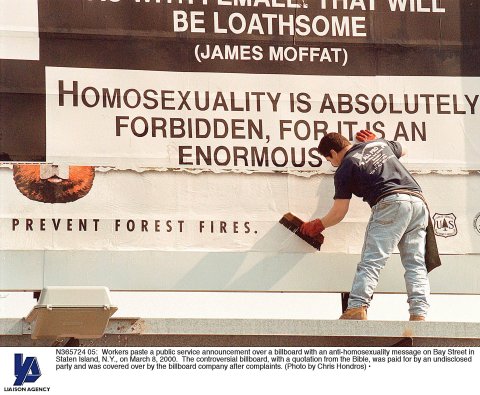
The declaration in ane Timothy—every bit recounted in the Living Bible, the New American Standard Bible, the New International Version Bible and others—could not be more clear: Those who "practice homosexuality" will non inherit the Kingdom of God. Simply the translation in that location is odd, in office because the give-and-take homosexual didn't even exist until more than i,800 years after when 1 Timothy was supposed to have been written. So how did it get into the New Attestation? Simple: The editors of these modernistic Bibles just fabricated information technology up. Like so many translators and scribes before them, they had a religious confidence, something they wanted to say that wasn't stated clearly enough in the original for their tastes. And and then they manipulated sentences to reinforce their convictions.
The original Bible verse in Koiné used ἀρσενοκοῖται for what has been translated equally "homosexual." For the Latin Bible, information technology was as masculorum concubitores. The Male monarch James Version translated that as "them that defile themselves with mankind." Perhaps that means men who appoint in sex with other men, perhaps non.
The next thing to check here is whether one Timothy was based on a forgery. And the reply to that is a resounding yes. In 1807, a German language scholar named Friedrich Schleiermacher published a letter observing that 1 Timothy used arguments that clashed with other letters written past Paul. Moreover, 1 Timothy attacks false teachings, simply they are not the types of teachings prevalent when Paul was writing—instead, they are more akin to the behavior of the Gnostics, a sect that did not exist until long after Paul's decease. And at times, whoever wrote this alphabetic character uses the same words equally Paul just means something completely different by them. Most biblical scholars agree that Paul did non write ane Timothy.
But suppose for a moment that 1 Timothy was written by Paul, and that "defile themselves" does refer to homosexuality. In that case, evangelical Christians and biblical literalists nevertheless have a lot of trouble on their hands. Opposite to what so many fundamentalists believe, outside of the emphasis on the 10 Commandments, sins aren't ranked. The New Attestation doesn't proclaim homosexuality the virtually heinous of all sins. No, every sin is equal in its significance to God. In i Timothy, Paul, or whoever wrote information technology, condemns the disobedient, liars and drunks. In other words, for evangelicals who want to use this book of the Bible to condemn homosexuality, about frat boys in America are committing sins on par with existence gay. Merely you lot rarely hear virtually parents banishing their kids for getting trashed on Sabbatum night.
Now permit'due south talk about how 1 Timothy deals with women. U.S. Representative Michele Bachmann, the Minnesota Republican, slammed gay people as bullies last March for opposing legislation that would accept allowed Arizona businesses to discriminate confronting same-sexual activity couples. Well, co-ordinate to the Bible, Bachmann should close up and sit downwards. In fact, every female political leader who insists the New Testament is the inerrant word of God needs to resign immediately or admit that she is a hypocrite.
That'south considering 1 Timothy is one of the most virulently anti-woman books of the New Attestation, something else that sets information technology autonomously from other letters past Paul. In the King James Version, it says women must dress modestly, tin can't embroider their pilus, tin can't wearable pearls or gold and have to stay silent. Moreover, they tin't concord any position of authority over men and aren't even immune to exist teachers—significant, if they truly believe the Bible is the inerrant discussion of God, women like Bachmann can't be in politics. In fact, while 1 Timothy has just one parenthetical clause that can exist interpreted every bit being most homosexuality, it contains six verses on the shortcomings of women and the limitations on what they are immune to exercise.
Many Christians indicate to other parts of the New Testament when denouncing homosexuality. Romans, another letter attributed to Paul, is a pop selection. In the King James Bible, it condemns men who animalism in their hearts for each other, a translation that holds upward pretty well when compared with the earliest Greek versions. And scholars agree that Romans is a real letter written past Paul.
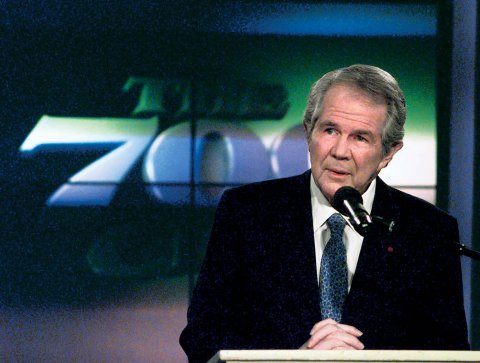
In other words, Romans is real Gospel, and what it has to say tin can't be questioned by those who call themselves biblical literalists. Which means televangelist Pat Robertson should prepare himself for an eternity in hell. On his television testify The 700 Club, Robertson recently went on a tirade about Barack Obama and, as he is wont to practise, prayed for aid. "God, we need the angels! We need your help!" Robertson said. "Nosotros demand to do something, to pray to be delivered from this president."
And with that, Pat Robertson sinned. Because in Romans—so often used to condemn homosexuality—there is a much longer series of verses about how the righteous are supposed to comport toward people in government potency. It shows up in Romans 13:1-ii, which in the International Standard Bible says, "The existing government take been established past God, so that whoever resists the authorities opposes what God has established, and those who resist will bring judgment on themselves."
And then yes, there is one verse in Romans most homosexuality…and there are eight verses condemning those who criticize the government. In other words, all fundamentalist Christians who decry Obama take sinned as much as they believe gay people have.
Information technology doesn't terminate there. In the same section of Romans that is arguably addressing homosexuality, Paul also condemns debating (all of Congress is damned?), being prideful, disobeying parents and deceiving people (yes, all of Congress is damned.) In that location is no assuming print or underlining for the section dealing with homosexuality—Paul treats it as something as sinful every bit pride or debate.
The story is the same in the last New Testament verse cited by fundamentalists who scorn homosexuals. Once again, it is a letter from Paul, chosen 1 Corinthians. The translation is good, and the experts believe it was written by him. But fundamentalists who rely on this amend stay out of court—Paul condemns bringing lawsuits, at least against other Christians. Adultery, existence greedy, lying—all of these are alleged as sins on par with homosexuality.
Of form, there are plenty of fundamentalist Christians who accept no idea where references to homosexuality are in the New Testament, much less what the surrounding verses say. And and so they e'er autumn dorsum on Leviticus, the Sometime Attestation book loaded with dos and don'ts. They seem to accept the words memorized nearly information technology being an anathema for a man to lie with a man as he does with a adult female. And every fourth dimension they brand that argument, they demonstrate that they know next to naught nearly the New Testament.
A cardinal conflict in the New Testament—arguably the most important one in the Bible—centers on whether the Laws of Moses were supplanted past the crucifixion of Christ. The bones tension there was that Paul led a church in Antioch where he attempted to bring gentiles into Christianity by espousing a liberal interpretation of the requirements to follow the Laws of Moses—circumcision, eating kosher food and other rules spelled out in the Old Testament. Hundreds of miles abroad, disciples of Jesus and his brother James headed a church in Jerusalem. When they heard about the goings-on in Antioch, a debate ensued: Did gentiles have to become Jews first (like Jesus) and follow Mosaic Police before they could be accepted equally Christians?
Some of the original disciples said yes, an opinion that seems to find support in words attributed to Jesus in the Gospel of Matthew: "Do non retrieve that I came to abolish the Police or the Prophets...." The author of Matthew made it clear that Christians must keep Mosaic Police force similar the most religious Jews, in order to achieve salvation. Simply Paul, especially in Galatians and Romans, says a person's salvation is won by his or her organized religion in Christ's death and resurrection—zero more. Those who try to follow Mosaic Constabulary, Paul believed, risked losing salvation.
In other words, Orthodox Jews who follow Mosaic Police can use Leviticus to condemn homosexuality without being hypocrites. But fundamentalist Christians must choose: They tin either follow Mosaic Law by keeping kosher, being circumcised, never wearing wearing apparel made of two types of thread and the like. Or they can accept that finding salvation in the Resurrection of Christ means that Leviticus is off the tabular array.
Which raises one final problem for fundamentalists eager to condemn homosexuals or anyone else: If they accept the writings of Paul and believe all people are sinners, then salvation is found in belief in Christ and the Resurrection. For everyone. At that place are no exceptions in the Bible for sins that evangelicals really don't like.
So evidently, God doesn't demand the help of fundamentalists in determining what should be done in the afterlife with the prideful, the greedy, the debaters or even those homosexuals. Which could well exist why Jesus cautioned his followers against judging others while ignoring their own sins. In fact, he had a specific word for people obsessed with the sins of others. He called them hypocrites.
They Haven't a Prayer
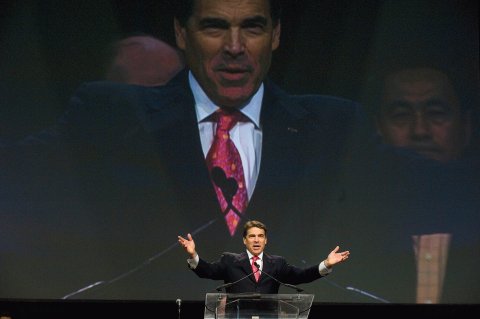
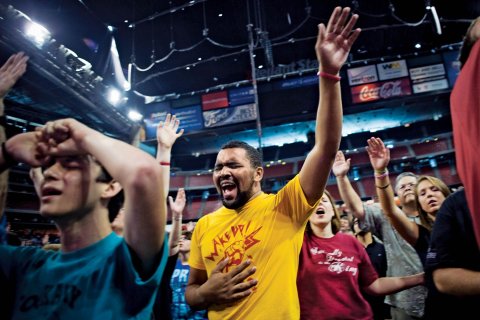
In August 2011, Texas Governor Rick Perry hosted a massive prayer rally in Houston at what was and so known as Reliant Stadium, where the city's pro-football squad plays. Joined past 30,000 fellow Christians, Perry stepped to a podium, his face projected on a giant screen behind him. He closed his eyes, bowed his head and boomed out a long prayer request God to brand America a better identify. His fellow believers stood, kneeled, cried and yelled, "Amen."
Recently, Louisiana Governor Bobby Jindal announced he would be holding his massive prayer rally at a sports arena in Baton Rouge. More than 100,000 evangelical pastors have been invited.
Jesus would have been horrified. At to the lowest degree, that's what the Bible says.
It is i of the about incomprehensible contradictions between the beliefs of evangelicals and the explicit words of the Bible. Prayer shows—and there is really no other give-and-take for these—are held every calendar week. If they are non at sports arenas with Republican presidential hopefuls, they are on Sunday morning television shows at mega-churches belongings tens of thousands of the faithful. They heighten their arms and sway, crying and pleading in prayer.
But Jesus specifically preached against this at the Sermon on the Mountain, the longest piece of education past him in the New Testament. Specifically, as recounted in the Gospel of Matthew, Jesus spoke of those who made large public displays of their ain religiosity. In fact, performance prayer events closely mimic the depictions in early Christian texts of prayer services held by the Pharisees and Sadducees, two of the largest religious movements in Judea during Jesus'south life. And throughout the Gospels, Jesus condemns these groups using heated language, with office of his acrimony targeted at their public prayer.
While the words in the King James Bible might exist a fleck confusing because it is non written in modern English, the New Revised Standard Version is a good substitute here. In it, Jesus is quoted as maxim "Beware of practicing your piety before others in order to be seen by them; for and then you have no reward from your Father in heaven."
But Jesus says much more than, specifically cautioning confronting the kind of public performance prayer that has become all the rage among evangelicals of belatedly. The verse in Matthew continues quoting Jesus, who says, "Whenever you pray, practice non exist like the hypocrites, for they dearest to stand and pray in the synagogues and at the street corners, and so that they may be seen by others. Truly I tell you, they have received their advantage."
Instead, Jesus says the truly righteous should pray alone and in secret, in a room with the door shut. "Your Male parent who sees in secret will reward yous,'' Jesus is quoted every bit saying.
Indeed, in the dozens of discussions in the Bible nigh prayer, the vast majority focus on God's ability to know what a person wants. In the New Testament, it is often portrayed as a deeply personal affair, with prayers uttered in prison house cells to a God who stays alongside the oppressed.
Moreover, babbling on as Rick Perry so many like him have virtually faith and country and the blessings of America runs counter to everything that Jesus says about prayer in the Bible. "When you lot are praying, exercise non heap upward empty phrases equally the Gentiles do, for they think that they volition be heard because of their many words,'' Jesus is quoted as maxim in Matthew. "Practise not exist similar them, for your Father knows what you need before y'all inquire him."
Because God knows what someone needs without being asked, there is no reason for long, convoluted prayers. Therefore, Jesus says in both Matthew and Luke, people who wish to pray should simply say the Lord's Prayer. Of course, there is the trouble that the Lord's Prayer cited in those two Gospels comes in two versions, so Christians have to choose one or the other.
It seems almost a phenomenon that those who effortlessly transform Paul'south statement about "them that defile themselves with flesh" into "homosexual" tin ignore the articulate, elementary words of Jesus in the Gospel of Matthew. What's well-nigh amazing is that, different and then many questions well-nigh the Bible, the instructions on how and where to pray are not only non contradicted; they are reinforced time and again.
The closest Jesus came to public prayer in the Bible was when he was feeding thousands with five loaves of bread and ii fish. This story is recounted in each of the Gospels, and each time, Jesus is depicted every bit either giving cheers to God or looking to heaven and blessing the food. But he is also depicted as praying in all four Gospels, and each time, Jesus does so after heading off to be solitary.
Some evangelicals have attempted to explicate away this contradiction between the words of the Bible in Matthew and modern public prayer performances by saying Jesus condemned only mass prayer, when the people doing it had fabricated that choice but to be seen. But with governors projected on giant, high-definition televisions, with thousands packed into sports stadiums weeping and waving, with thousands more than doing their prayers on Goggle box at mega-churches, it's hard to run into what possible reason might exist other than to exist seen. God, the Bible makes clear, didn't demand anyone to drive to a football stadium and then he could hear them.
Which leads to an obvious question: Why don't more Christians oppose prayer in school? If these people truly believe that the Bible is the Give-and-take of God, then their children should exist taught the Lord'southward Prayer, brought to their rooms and allowed to pray alone.
That answer doesn't lend itself to big protests or angry calls for impeaching judges. But it does follow the instructions from the Gospels. And isn't that supposed to be the indicate?
Guess Not
So why study the Bible at all? Since information technology's loaded with contradictions and translation errors and wasn't written by witnesses and includes words added past unknown scribes to inject Church orthodoxy, should it but be abased?
No. This examination is not an attack on the Bible or Christianity. Instead, Christians seeking greater agreement of their religion should view it every bit an attempt to relieve the Bible from the ignorance, hatred and bias that has been heaped upon it. If Christians truly want to treat the New Testament every bit the foundation of the religion, they have to know it. Too many of them seem to read John Grisham novels with greater care than they apply to the book they consider to be the most important document in the globe.
But the history, complexities and actual words of the Bible can't be ignored simply to line information technology upwardly with what people desire to believe, based only on what friends and family and ministers tell them. Nowhere in the Gospels or Acts of Epistles or Apocalypses does the New Attestation say it is the inerrant word of God. Information technology couldn't—the people who authored each section had no idea they were composing the Christian Bible, and they were long expressionless before what they wrote was voted by members of political and theological committees to be the New Testament.
The Bible is a very human book. It was written, assembled, copied and translated past people. That explains the flaws, the contradictions, and the theological disagreements in its pages. Once that is understood, it is possible to discover out which parts of the Bible were not in the primeval Greek manuscripts, which are the bad translations, and what one book says in comparison to another, then endeavour to discern the message for yourself.
And comprehend what modern Bible experts know to exist the true sections of the New Testament. Jesus said, Don't judge. He condemned those who pointed out the faults of others while ignoring their own. And he proclaimed, "Thou shalt love thy neighbour as thyself. There is none other commandment greater than these."
That's a good place to commencement.
Source: https://www.newsweek.com/2015/01/02/thats-not-what-bible-says-294018.html
0 Response to "It Is Not Accidental Therefore Tha Thte Biblical Story of the Fall Is Centered Again on Food"
Post a Comment